Christian Chacua Profile Picture

Christian Chacua

Growth Lab Postdoctoral Research Fellow
Harvard Center for International Development

My research focuses on the economics of science, geography of innovation, science of science, high-skilled migration, and knowledge diffusion.
Contact Information

christian_chacua@hks.harvard.edu

Research

Publications

Innovation Policies Under Economic Complexity Cover
Innovation Policies Under Economic Complexity
with Ricardo Hausmann (Harvard), Muhammed A. Yildirim (Harvard), Shreyas Gadgin Matha (Harvard), and Matte Hartog (Harvard)
We examine how innovation policies can better address development challenges by focusing on countries' existing capabilities and the complex and tacit nature of knowledge. We argue that effective policies should be place-based and multidimensional, rather than imitating solutions from elsewhere, to support sustainable economic growth.
Global Trends in Innovation Patterns Cover
Global Trends in Innovation Patterns: A Complexity Approach
with Ricardo Hausmann (Harvard), Muhammed A. Yildirim (Harvard), Shreyas Gadgin Matha (Harvard), and Matte Hartog (Harvard)
We analyze global innovation patterns using data on scientific publications, patents, and trade, finding that economic complexity in each of these domains is closely linked to future growth, patenting, and publishing. Our results show that a country's embedded capabilities shape both its future diversification opportunities and the path-dependent nature of innovation.
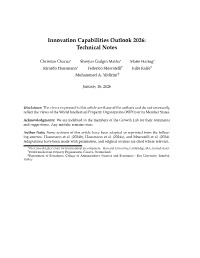
Can We Map Innovation Capabilities Cover
Can We Map Innovation Capabilities?
with Federico Moscatelli (WIPO), Shreyas Gadgin Matha (Harvard), Matte Hartog (Harvard), Eduardo Hernandez Rodriguez (Utrecht), Julio Raffo (WIPO), and Muhammed A. Yildirim (Harvard)
We measure innovation capabilities across science, technology, and production, using data from publications, patents, and trade. Our results reveal that higher innovation complexity is linked to economic growth and that existing capabilities predict future innovation, emphasizing the need for nuanced policy indicators and strategies.
The Missing Link: International Migration in Global Clusters of Innovation
with Massimiliano Coda-Zabetta (Bordeaux), Francesco Lissoni (Bordeaux), Ernest Miguelez (Bordeaux), Julio Raffo (WIPO), and Deyun Yin (WIPO)
This chapter analyzes global innovation clusters using geo-localized patent and publication data, emphasizing the impact of high-skilled migrants. It finds that migration-driven personal connections are often as important as, or more important than, organizational collaborations in cluster success.
Tied In: The Global Network of Local Innovation Cover
Tied In: The Global Network of Local Innovation
with Ernest Miguelez (Bordeaux), Julio Raffo (WIPO), Massimiliano Coda-Zabetta (Bordeaux), Deyun Yin (WIPO), Francesco Lissoni (Bordeaux), and Gianluca Tarasconi (ipQuants)
This paper uses global patent and publication data to show that knowledge production has expanded to more countries beyond traditional innovation hubs, driven in part by the rise of Global Innovation Networks. However, within countries, knowledge activities remain concentrated in a few hotspots, leading to greater connectivity among these areas and potential distributional challenges.

Research In Progress

A Century of Faculty Globalization and University Rise: From US-Born, Foreign-Educated to Foreign-Born, US-Educated
with Frank Neffke (CSH)
Presented at NBER, CSH, GeoInno, DRUID, and ResPol
We examine the educational backgrounds and career trajectories of U.S. faculty from 1880 to 1990, to understand the reliance of U.S. universities on foreign-educated and foreign-born faculty. Our findings reveal that over a century, U.S. universities transitioned from relying U.S.-born, foreign-educated to foreign-born, U.S.-educated faculty.
Burning Bridges or Bridging Divides: Geopolitics and Collaboration in Research and Innovation
with Ricardo Hausmann (Harvard), Pierre Alexandre Balland (CEPS), Shreyas Gadgin Matha (Harvard), Matte Hartog (Harvard), and Muhammed A. Yildirim (Harvard)
Revise and Resubmit to Research Policy
We analyse the effects of geopolitical tensions on international research and innovation collaborations. We find that belonging to different geopolitical blocs significantly reduces the likelihood of collaboration, and this association is even more pronounced in critical technologies.
The Geographic Content of Research: Stylized Facts on the Places That Get Studied
with Richard B. Freeman (Harvard), Ricardo Hausmann (Harvard), Vincent Larivière (Montreal), and Cassidy R. Sugimoto (Georgia Tech)
Presented at IEA-WC, Granada, Harvard, ICSSI, and Growth Lab
A paper describing stylized facts and listing potential research avenues for geographic content metrics. It extracts geographic content from titles and abstracts using simple NLP models.
Migration and Changes in Research Interest: A Life Cycle Analysis
with Richard B. Freeman (Harvard)
Presented at UNAL, PennState, Atl. Conf., Col. Conf, YSI, ICSS, IZA, WOEPSR, Bordeaux, Atl. Acad., Barcelona, WICK, Max Planck, RIE-MEIDE, Thessaloniki, and Harvard
We study how migration changes the geographic focus of research by Colombian scientists. We find that scientists who initially studied Colombia begin to study other countries after leaving Colombia.
Combining Minds to Decode Technological Recombination and Relatedness
with Ricardo Hausmann (Harvard), Shreyas Gadgin Matha (Harvard), Matte Hartog (Harvard), Muhammed A. Yildirim (Harvard), Federico Moscatelli (WIPO), and Julio Raffo (WIPO)
Presented at Growth Lab
We study how technologies combine in a single individual and in collectives of individuals and firms. We find that although a single individual combines a median of two technologies, and a country combines 155, both produce a similar number of technology-technology combinations. However, the strength and significance of these associations are highly heterogeneous.
Inequalities and Hierarchies in a Century of U.S. Faculty Hiring
with Frank Neffke (CSH)
Presented at ICSSI
We study the historical origins of current prestige hierarchies and patterns of inequality in US faculty hiring. We find that, since 1880, the supply (education) of US faculty has been highly concentrated in a few universities. Prestige hierarchies have remained persistent, even though the most prestigious universities in 1880 differ from those of today.
Cross-Domain Capabilities: Mapping the Links Between Science, Technology, and Production
with Ricardo Hausmann (Harvard), Shreyas Gadgin Matha (Harvard), Matte Hartog (Harvard), Muhammed A. Yildirim (Harvard), Federico Moscatelli (WIPO), and Julio Raffo (WIPO)
A paper proposing an empirical methodology to map the linkages between science, technology, and production capabilities. Our findings reveal that having strong scientific and production capabilities in cross-related domains predicts subsequent technological development.

Research On Hold

Ethnicity and Collaboration in Inventor Networks
with Ernest Miguelez (Bordeaux) and Francesco Lissoni (Bordeaux)
A paper studying the role of ethnicity, inferred from name analysis, in inventor collaborations. After controlling for different types of proximity measures, we find that inventors from the same ethnicity have a larger probability of collaborating to file a patent.
Identifying Innovation World Clusters from Multidimensional Georeferenced Data
with Ernest Miguelez (Bordeaux) and Julio Raffo (WIPO)
Revise and Resubmit to European Planning Studies
A paper describing a methodology to define geographic cluster boundaries from millions of georeferenced data.

Monographs/Theses

The Geography of Knowledge: Essays on Migration and Science
Ph.D. Thesis (University of Bordeaux, 2022)
Advisors: Ernest Miguelez and Valerio Sterzi
Committee: Cassidy Sugimoto (Georgia Tech), Ron Boschma (Utrecht), Megan MacGarvie (Boston Univ.), and Eric Rougier (Bordeaux)
Intermediarios en las exportaciones Colombianas
Title translation: Intermediaries in Colombian Exports
Bachelor's Thesis (Universidad del Valle, 2014)
Advisor: Boris Salazar Trujillo